In this article, you will read in a few short steps how to use the Notification Dangerous Goods service.
How does Notification Dangerous Goods work?
Dangerous cargo on arrival
In the top section, you specify the dangerous and/or harmful cargo that is on board when the vessel arrives in the port. For bulk vessels, you specify this per tank or hold.
Handling per berth
The screen automatically shows all berths visited during the vessel call, as entered in the Visit screen. For each berth, you specify the cargo operations that take place there. This includes loading and discharge activities in any case. For liquid bulk, you also specify cleaning activities (washing, ventilation) and inerting here.
Dangerous cargo on departure
The PCS automatically derives the dangerous and/or harmful cargo on departure from your specifications above. You therefore do not need to enter anything else.
In the PCS, you can request Municipalities of Rotterdam, Dordrecht, Maassluis, Moerdijk, Papendrecht, Schiedam, Vlaardingen and Zwijndrecht. upon arrival. This also applies to the exit point; there the PCS shows the cargo that is on board when leaving the port.
Complete the notification and send
When you have finished registering the dangerous goods, click Complete. This opens the screen where you can send the notification.
General functionalities
Upload stowage form
You can download an empty Excel form and have the dangerous and/or harmful cargo on arrival filled in by the master or crew. You then upload the completed form in the screen and use it in your notification to the Harbour Master.
Download stowage on departure
You can download the dangerous and/or harmful cargo on board on departure (automatically calculated by the PCS) as an Excel form. You can upload this form again later for a next call.
Partial discharge of bulk cargo
When specifying a discharge activity, you can indicate that a tank or hold is only partially discharged. You then specify the quantity that is discharged at that berth.
Based on the quantity on arrival and the discharged quantity, the PCS automatically calculates how much is still on board on departure. This way, you only have to enter the data for this substance once (in the cargo on arrival).
Lightering
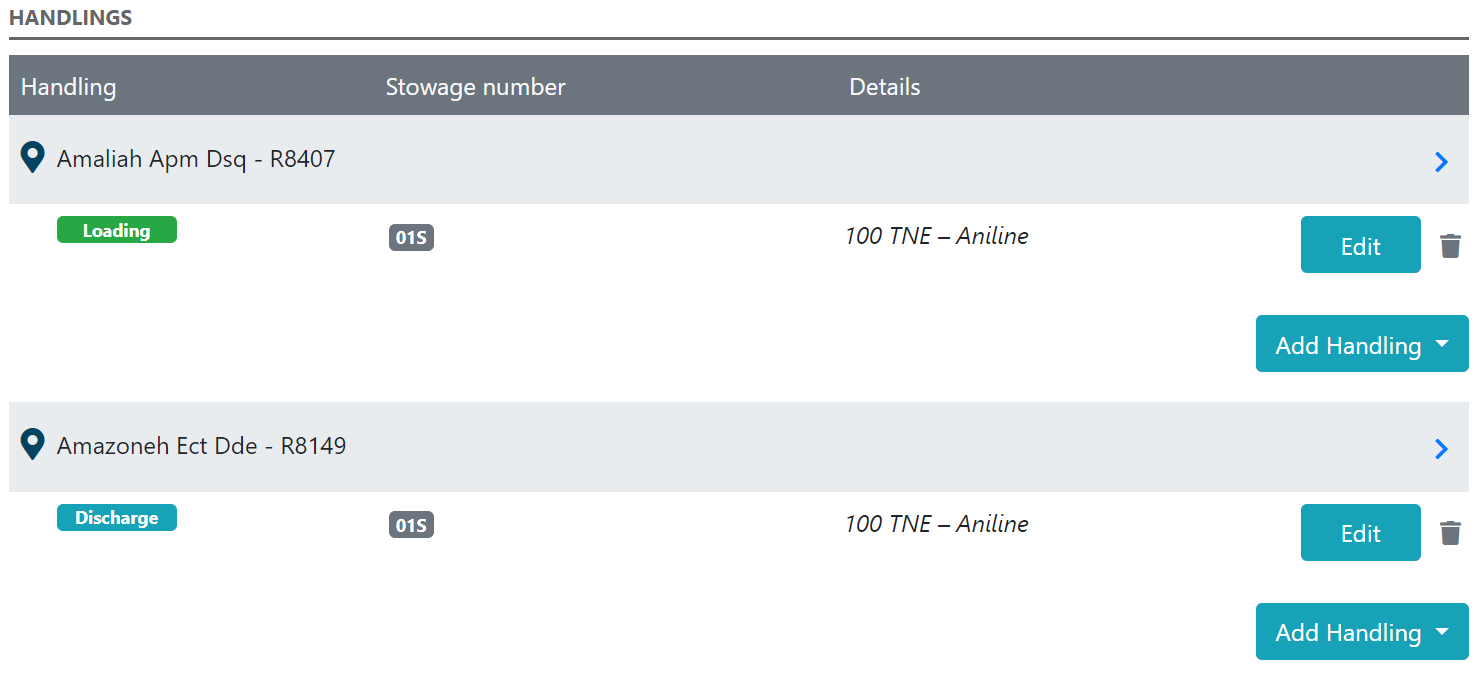
In the notification application, you can now also easily report lightering (loading and discharging within the same vessel call). You do this by reporting the cargo operation at one berth and the discharge operation at the other berth.
 Transit
For transit cargo, you enter it under cargo on arrival. You do not need to specify handling for this cargo, because transit means that no handling takes place. The PCS automatically includes this cargo again under cargo on departure.
Liquid bulk
Cargo on arrival (Tanks at Arrival)
You are required to report empty, unclean cargo tanks to the Harbour Master.
To maintain an overview and prevent you from forgetting one or more tanks, you include the vessel’s full tank configuration in Tanks at Arrival.
Then, for each tank you specify the status:
not empty – tank with cargo
residue – residue remaining after discharge
not gas free – cleaned but not ventilated
empty – clean and ventilated
For each of these statuses, add inert if applicable.
Slop tanks
You can include special slop tanks (or cargo tanks in which wash water is stored) as regular cargo tanks, and specify the status Residue (inert).
In the tank coding, add an S in the third position to indicate that it is a slop tank. For example: 03SP, 04SS.
As the substance name, enter the most determining substance from which the wash water originates. In the remarks field, indicate that it concerns wash water.
Cargo operations (Handlings)
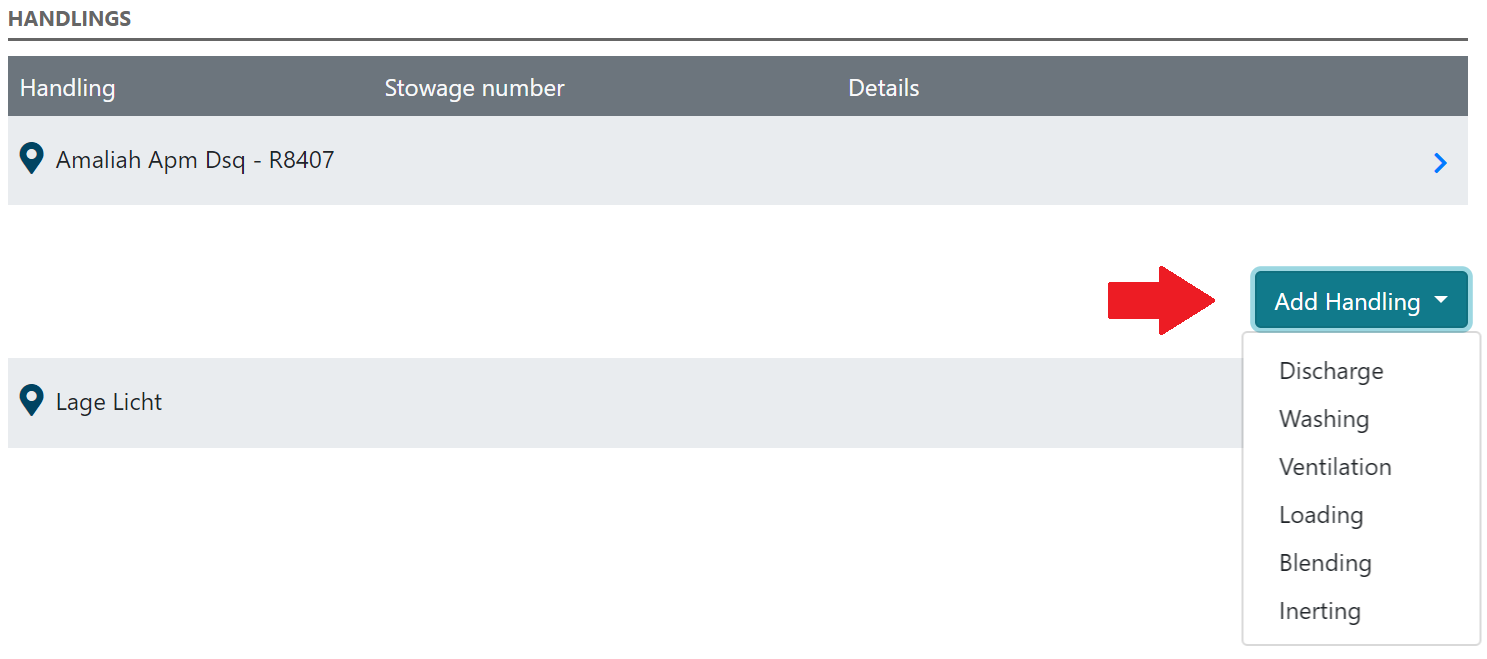
For each berth, you specify which handling takes place and for which tank(s).
The handling types are:
Discharge
Washing
Ventilation
Loading
Blending
Inerting
Only tanks included in Tanks at Arrival can be selected for handling at a berth.
Based on the tank status, the PCS automatically determines which types of handling are possible. For example, you cannot apply Washing to non-empty tanks. In this way, the system reduces the chance of input errors.
 Washing / Ventilation
If cleaning is carried out at a berth, add a handling of type Washing for that berth. You can indicate whether it concerns a pre-wash or a medium/commercial wash.
For a commercial wash, you also specify the destination of the wash water:
on board in the same tank
on board in another tank
ship-to-ship
ashore
In addition, for a commercial wash you can indicate whether ventilation takes place directly after washing.
For tanks that have already been washed and only still need to be ventilated, use the handling Ventilation.Blending
Topping up tanks with the same substance can be done via a regular Loading handling.
If another substance is added to the cargo in a tank and this creates a new (dangerous and/or harmful) substance, use the handling Blending. You then specify:
which substance is being loaded (free text; does not have to be dangerous or harmful)
which dangerous and/or harmful substance is created as a result
the quantity that was added
Inerting
To ensure that the PCS can correctly determine the status of the tanks on departure, it is important to also specify any inerting of tanks.
Dry bulk
Cargo on arrival (Holds at Arrival)
In this section, you include the holds that contain dangerous and/or harmful cargo when arriving in the port.
Holds with bulk cargo that has not been designated as dangerous or harmful do not have to be reported (unless they have been fumigated, see below).
Empty holds also do not have to be reported.
Different substances in one hold
The notification application assumes a maximum of one substance per hold. If a hold is divided by bulkheads and therefore contains different substances, you include these as separate Position entries. For example, you do this by adding a letter after the hold identification.
Fumigated cargo
For bulk cargo that has been fumigated abroad, you can indicate in the hold details that this hold is Fumigated. Then fill in the required data.
In addition to this notification, for fumigated cargo you must submit an additional statement. This statement concerns:
the hiring of a fumigation expert
working according to an approach plan (PvA)
approval from the berth owner
Fumigated bulk cargo that is not dangerous and/or harmful cargo
For the time being, this cargo can only be reported as Breakbulk.
In that case, enter:
Cargo: Fumigated Cargo transport unit UN 3359 Class 9
Position: the hold number
Gross Weight: the quantity of cargo
Remarks: the name of the fumigant used, the date of treatment with the fumigation agent, and the company name of the fumigation expert leading the operation
- Choose the fumigation method. If you select the fumigation method phosphine, aluminium phosphide or magnesium phosphide in the dropdown, you must indicate whether sleeves were used or loose tablets. In addition, you must also specify:
- the number of sleeves added in the port of loading;
- the number of sleeves with residues that have been removed;
- the name and contact details of the commissioning party for the fumigation supervisor;
- the name and contact details of the fumigation supervisor who is accompanying the vessel;
- the name and contact details of the company that provides the discharge and the “muieren” of the vessel;
Packed (containers, trailers and general cargo)
Cargo on arrival (Containers at Arrival)
In this section, you include the containers that contain dangerous and/or harmful cargo on arrival in the port.
Containers without dangerous or harmful substances do not have to be reported.
Exception: empty tank containers that still contain cargo residues (including vapours). For these containers, you specify the relevant substance and that they are Unclean. The PCS then automatically sets the quantity data to zero.
Packaging
For Outer packaging, you specify the outermost packaging layer inside the container (the container itself does not count as packaging).
For Inner packaging, you specify the inner packaging.
Stowage for container vessels
In accordance with ISO standard 9711-1, you report stowage on container vessels in the format Bay/Row/Tier: BBBRRTT.
If the bay number contains fewer than three digits, add a zero (0) in front of it.
The PCS automatically completes this to seven positions.
Stowage for RO-RO vessels
You also report containers on RO-RO vessels as containers. The format of the stowage locations differs from that of container vessels:
0011333XXX44
00 = Deck
11 = Lane
333 = Position
XXX = Reference Point (FOR or FRN)
44 = Level
Restowage
If, during loading or discharge, transit containers are placed in a different position on board, you can easily indicate this with the Restow handling.
For each container, you then specify the new stowage position.
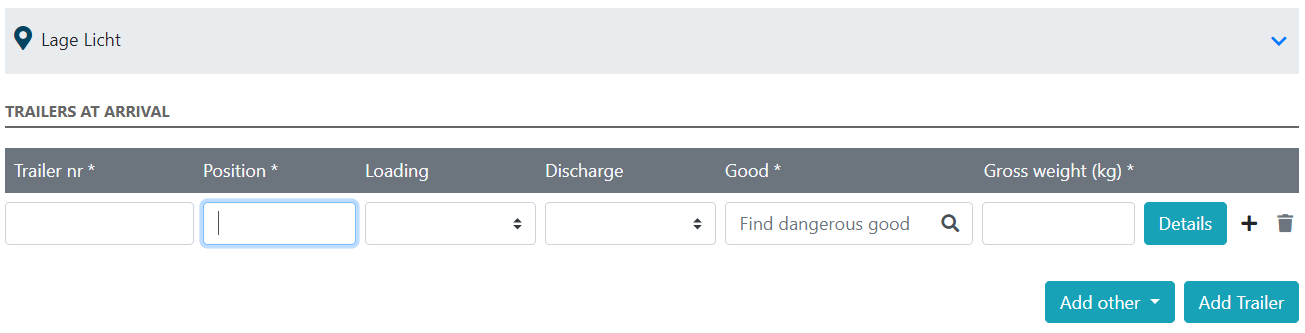
Cargo on arrival (Trailers at Arrival)
In this section, you include the trailers that contain dangerous and/or harmful cargo on arrival in the port.
Trailers without dangerous or harmful substances do not have to be reported.
In the same way, you also specify trucks with fixed tilt that contain cargo.
For Outer packaging, you enter the outermost packaging layer inside the trailer.
For Inner packaging, you enter the inner packaging.
Trucks and trailers are usually transported on RO-RO vessels. The format of the stowage locations on RO-RO vessels is: Deck/Lane/Position(FOR or FRN)/Level.
 Cargo on arrival (Breakbulk on Arrival)
In this section, you include the breakbulk items that contain dangerous and/or harmful substances on arrival in the port.
The PCS automatically numbers these breakbulk items. You use these numbers to identify the cargo items during the discharge activities.
For Outer packaging, you enter the outermost packaging layer of the breakbulk. For Inner packaging, you enter the inner packaging.
Part of